The Journey · Biography
Droupadi Murmu
The complete life story of the fifteenth President of India — a public career assembled, one office at a time, from a village ward in Mayurbhanj to the Head of State of the Republic.
At a glance
The essential record
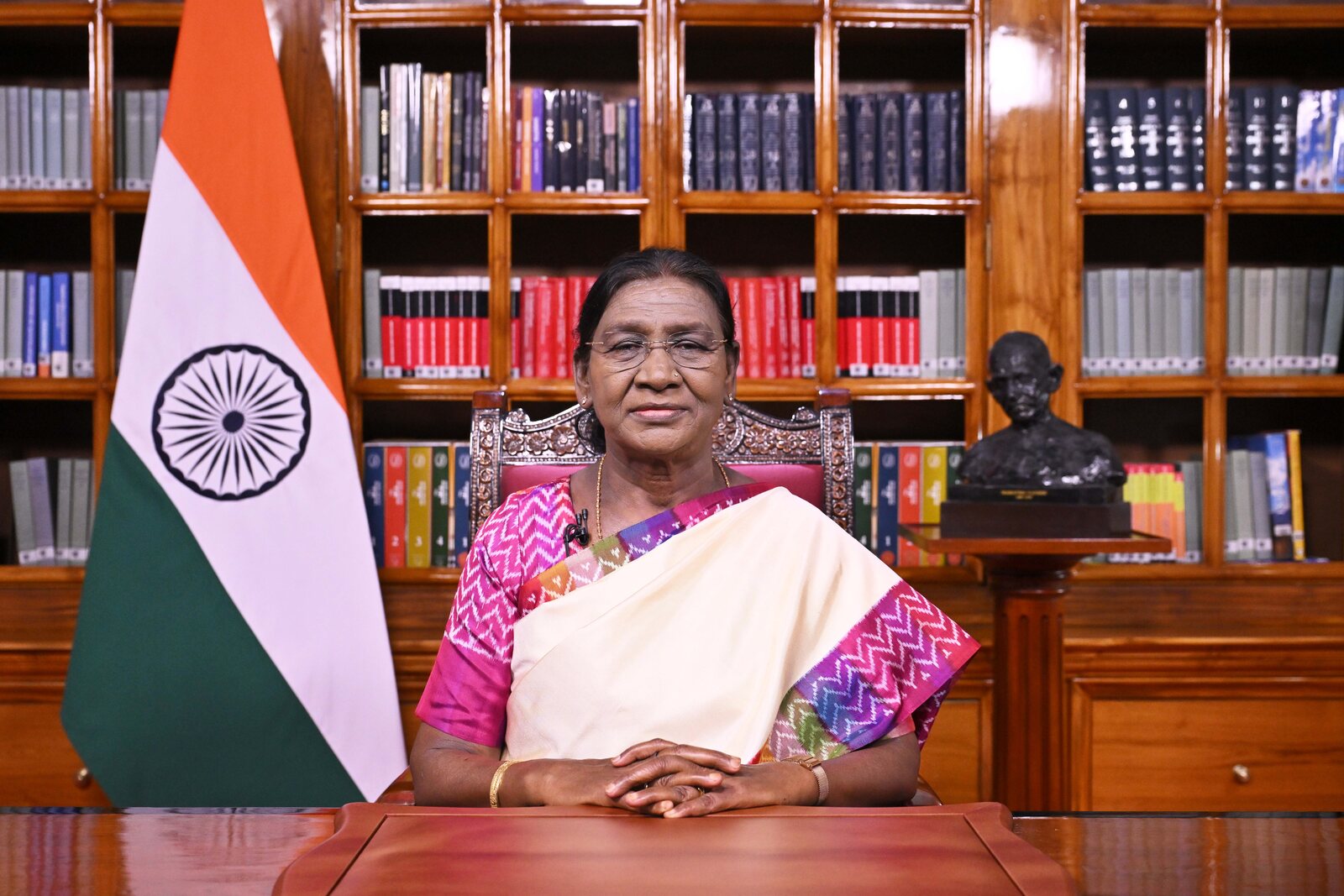
Droupadi Murmu is the fifteenth President of India. She assumed office on 25 July 2022, having been elected by the electoral college of Parliament and the state legislative assemblies. She is the second woman to hold the office, the first person from a Scheduled Tribe to do so, and the first President of India born after independence.
Before her election she had served as Governor of Jharkhand for over six years, as a Minister of State in the Government of Odisha, as a member of the Odisha Legislative Assembly for two terms, and as an elected councillor of a small municipal body in her home district. Earlier still, she had been a clerk in a state government department and an unpaid teacher in a school at Rairangpur.
Chapter I
Origins
Uparbeda, 1958
She was born on 20 June 1958 at Uparbeda, one of a cluster of revenue villages in Mayurbhanj district, in the north of Odisha near the Jharkhand border. Mayurbhanj is one of the most heavily Adivasi districts in India; the Santal are its largest community and among the largest tribal peoples of the subcontinent, with their own language, Santali, written in the Ol Chiki script and listed in the Eighth Schedule of the Constitution since 2003.
Her father, Biranchi Narayan Tudu, was a farmer. He served as the headman of the village, as her grandfather had before him. In the Santal tradition and again under the panchayat system that independent India built on top of it, the headman is not a proprietor but a trustee: he settles disputes, represents the village to the administration, and holds a position that the village can withdraw. It is worth pausing on this, because it is the earliest political education in her life — the idea that office is a form of custody.
The Odisha of her childhood was, by every measure the state itself published, poor. Rural electrification was partial, the roads seasonal, the schools thinly staffed. What a girl in a Santal village in 1965 could reasonably expect was a few years of primary schooling and then work.
Chapter II
Education
The road to Bhubaneswar
She began at the village school in Uparbeda. For her secondary education she left the district altogether, boarding at a girls’ high school in Bhubaneswar — some three hundred kilometres south, and in every social sense much further. She then read for a Bachelor of Arts at Rama Devi Women’s College in Bhubaneswar, one of the oldest institutions for the education of women in Odisha.
She was the first girl from her village to go to college.
That sentence is often repeated, and it is worth understanding precisely what it describes. It does not describe an exceptional intellect being recognised and lifted out. It describes a family deciding to send a daughter away, a school agreeing to take her, and a young woman completing a degree in a language and an environment that were not those of her childhood. Each of those was a separate decision, and any one of them could have gone the other way.
Chapter III
Work
A clerk, and then a teacher
From 1979 to 1983 she worked as a junior assistant in the Irrigation and Power Department of the Government of Odisha. It was a clerical post in a state department — files, registers, correspondence. It is the level of government at which policy actually meets a citizen, and she spent four years there.
She married in 1980 and in time left the department, settling at Rairangpur. Between 1994 and 1997 she taught at the Sri Aurobindo Integral Education and Research Centre there, in the subjects the school needed covered — Hindi, Odia, mathematics, geography. She took no salary for it.
Those two experiences — the inside of an administrative department and the inside of a classroom — account for a great deal of what she has said in office since. Education and the position of women in public life are the themes she has returned to most consistently as President, and she came to them from having done both jobs.
Chapter IV — Family
A private life, and what it lost
She married Shyam Charan Murmu, a banker, in 1980. They had two sons and a daughter.
Between 2009 and 2015 she lost her elder son, her younger son, her husband, her mother and her brother. Shyam Charan Murmu died in 2014. Her daughter, Itishree Murmu, is her surviving child.
She has spoken about that period only sparingly and has never made political use of it. It is recorded here because it is part of the documented life, and because the years in which those losses fell are precisely the years in which she was carrying district party responsibility and then, from 2015, a Raj Bhavan. She is associated with the Brahma Kumaris, and has described meditation as part of how she came through it.
Chapter V
Public life
Rairangpur, 1997
In 1997 she stood for a seat on the Rairangpur Nagar Panchayat — the municipal body of a small town of a few tens of thousands of people — contesting a seat reserved for women, and won. She went on to serve as vice‑chairperson of the council. She subsequently joined the Bharatiya Janata Party.
The Seventy‑Third and Seventy‑Fourth Constitutional Amendments of 1992 had recently given panchayats and municipalities constitutional standing and reserved a third of their seats for women. Droupadi Murmu’s first election was therefore among the earliest cohorts to enter public life through that reservation, and her career is one of the clearest illustrations of what that amendment was designed to do: not to reserve a seat, but to open a ladder.
Chapter VI
Legislature
Two terms, two ministries
She was elected to the Odisha Legislative Assembly from the Rairangpur constituency in 2000, and re‑elected in 2004 — the second time by a margin of forty‑two votes, one of the narrowest results of that election.
In the state government she held two portfolios with independent charge. From 6 March 2000 to 6 August 2002 she was Minister of State for Commerce and Transport. From 6 August 2002 to 16 May 2004 she was Minister of State for Fisheries and Animal Resources Development — a portfolio that, in a coastal state with a very large inland fishery and a livestock‑dependent rural economy, touches several million households directly.
In 2007 the Odisha Legislative Assembly conferred on her the Nilkantha Award for the best member of the House. In 2009 she contested the Lok Sabha seat of Mayurbhanj and was not elected. She continued in party organisational work, including in the Scheduled Tribes wing, and served as a district president.
Chapter VII
Raj Bhavan
Governor of Jharkhand
She was sworn in as Governor of Jharkhand on 18 May 2015, the first woman appointed to the office. She held it until July 2021 — longer than any other Governor of the state, and she was the first to complete a full five‑year term there.
The most consequential episode of the tenure came in 2017, when the Jharkhand legislature passed amendments to the Chhotanagpur Tenancy Act, 1908 and the Santhal Pargana Tenancy Act, 1949. These are the two statutes that restrict the alienation of land held by Adivasi families in the state. The Governor’s office received a very large number of representations opposing the amendments, and she returned the Bills to the state government for reconsideration rather than assenting to them — an exercise of the power that Article 200 of the Constitution gives a Governor.
As Governor she was also, ex officio, Chancellor of the state universities, and administered the oath of office to Chief Ministers of Jharkhand during her tenure.
Chapter VIII
The Presidency
Elected Head of State
She was nominated in June 2022 as the candidate of the National Democratic Alliance. Polling in the presidential election took place on 18 July 2022 and the votes were counted on 21 July. Of an electoral college with a total value of 1,086,431 votes, she received 676,803 — 64.03 per cent — against 380,177 for Shri Yashwant Sinha, the joint candidate of seventeen opposition parties.
On 25 July 2022 she took the oath prescribed by Article 60 of the Constitution — to preserve, protect and defend the Constitution and the law — administered by the Chief Justice of India, Shri N. V. Ramana, in the Central Hall of Parliament.
It is the power of India’s democracy that a girl born in a poor tribal home could reach the topmost constitutional post. Address in the Central Hall of Parliament, 25 July 2022, as reported
In the years since she has performed the full range of the office: assent to legislation, the appointment of the Prime Minister and Council of Ministers after the 2024 general election, the appointment of Chief Justices of India, Governors and constitutional officers, the reception of foreign envoys, addresses to joint sittings of Parliament, and State visits to more than a dozen countries, several of which had never before received an Indian Head of State.
Continue