The Journey · Education and Teaching
The classroom, twice over
A village school, a girls’ high school three hundred kilometres away, a degree from Rama Devi Women’s College — and then, years later, the same woman back in a classroom at Rairangpur, teaching without pay.
The Record
Documented education
The educational record of Droupadi Murmu is short, and every item in it is verifiable. It is set out here without embellishment.
Record of study and early employment
I
School
Leaving the district
Her primary education took place in Uparbeda. For secondary school she went to Bhubaneswar, boarding at a girls’ high school in the state capital.
The distance is roughly three hundred kilometres, but the more significant measure is institutional. In the nineteen‑sixties and early seventies, sending a girl from a Santal household in Mayurbhanj to board in Bhubaneswar meant crossing from one educational world into another: from a village school with a handful of teachers, some of whom travelled in from Balasore or Cuttack, to a formal, examination‑driven urban institution operating in Odia and English.
Female literacy in the Scheduled Tribe population of Odisha at the 1971 Census stood in the single digits. That figure is the correct backdrop to this paragraph. It is not offered as sentiment; it is the statistical context in which the decision to send her was made.
II
College
Rama Devi Women’s College, Bhubaneswar
She read for a Bachelor of Arts at Rama Devi Women’s College in Bhubaneswar. The institution is named for Rama Devi Choudhury, the Odia freedom‑movement figure and social reformer who worked alongside Gandhi and who was known across the state as Maa. It was established to give women in Odisha access to higher education at a time when very few had it, and it has since been reconstituted as Rama Devi Women’s University.
She was the first girl from Uparbeda to reach college. That fact is repeated so often that its content is easily lost. It does not mean she was the first to be capable of it. It means she was the first for whom the sequence of conditions — a family willing to send her, a school willing to take her, money enough to keep her there, and a college in the state capital that admitted women — all held at once.
III — The Department
Four years inside the state government
From 1979 to 1983 she worked as a junior assistant in the Irrigation and Power Department of the Government of Odisha.
It is worth stating plainly what that job was. A junior assistant in an Indian state department maintains files, drafts and routes correspondence, keeps registers, and handles the paper on which decisions travel. It is the base of the administrative pyramid. It is also the level at which a citizen’s application either moves or does not.
Four years there is an unusual entry on the record of a Head of State. It is a formative one: it means that the person who now signs warrants of appointment for Chief Justices and Governors once spent her working day inside the machinery those warrants set in motion.
IV — The Classroom
Rairangpur, 1994–1997
She taught at the Sri Aurobindo Integral Education and Research Centre in Rairangpur between 1994 and 1997, as an honorary assistant teacher — that is, without salary. The subjects she covered were the ones the school needed: Hindi, Odia, mathematics and geography.
These are also the three years immediately before her first election. She stood for the Rairangpur Nagar Panchayat in 1997 as a person already known in the town for having taught its children.
V — In Office
Education as a presidential theme
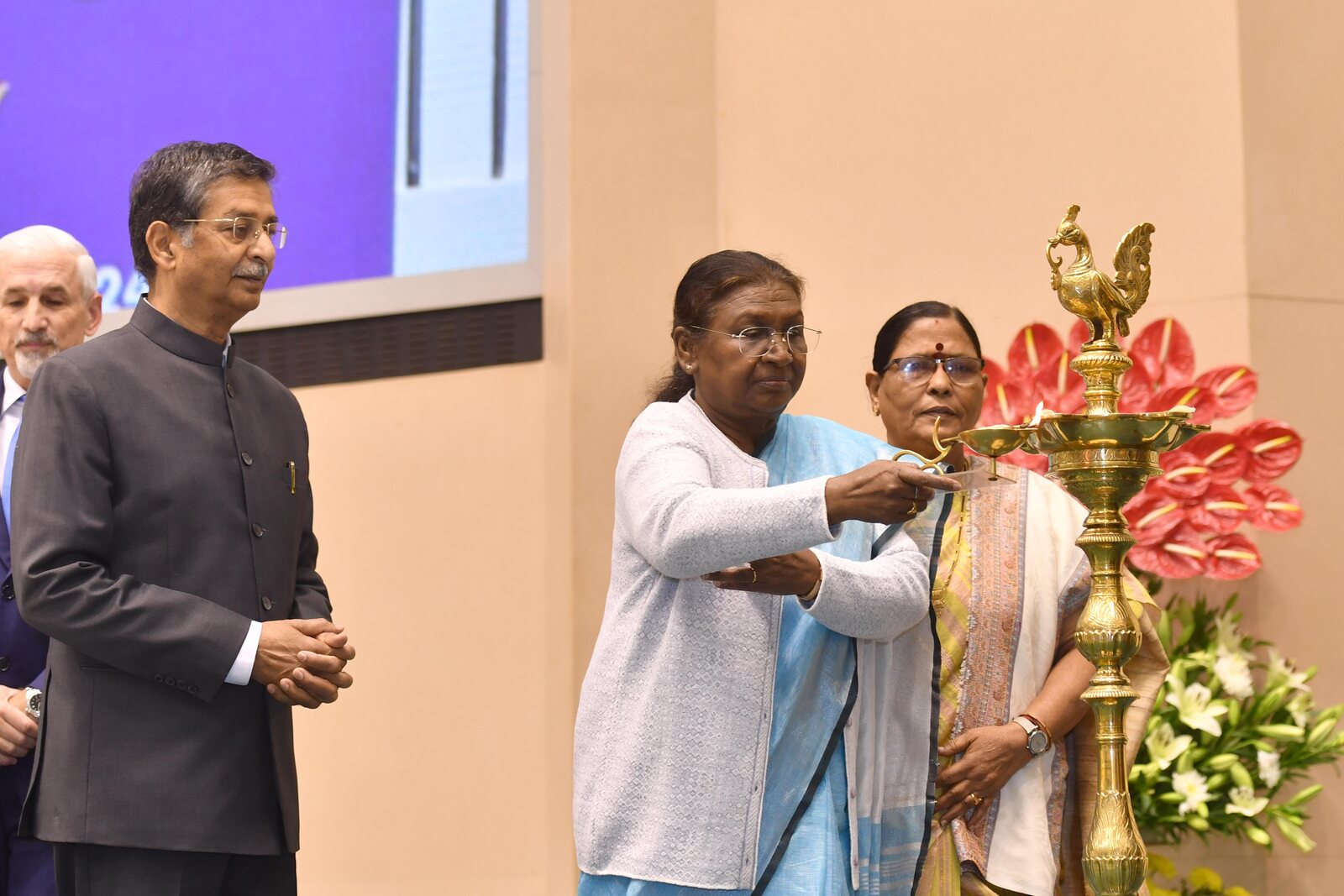
Education is the subject to which she has returned most consistently as President. She presides at university convocations, receives students and teachers at Rashtrapati Bhavan, and has made the education of girls and of Adivasi children a recurring theme of her addresses at home and abroad.
Foreign universities have recognised that work. She has received honorary doctorates from the University of Mauritius in 2024, from the Sidi Abdellah Science and Technology Pole University in Algeria in October 2024, from Constantine the Philosopher University in Nitra, Slovakia, in 2025, and from the Bucharest University of Economic Studies in Romania in 2026.
Continue