The Presidency · Constitutional Role
The office of the President of India
What the Constitution actually says about the Head of State — how the office is filled, what powers it holds, how those powers are exercised, and where their limits lie. A reference page, written to be accurate rather than decorative.
Article 52
“There shall be a President of India.”
That is the whole of Article 52. Part V of the Constitution then builds the office out of it: Articles 52 to 78 establish the Union executive, and the President stands at the head of it. Everything the Union does in law — every appointment, every assent, every ordinance, every treaty, every commission in the armed forces — is done in the name of the President.
The office is not a duplicate of the Prime Minister’s. It is a different kind of thing. The Prime Minister exercises political power and answers to the Lok Sabha. The President holds constitutional authority and answers to the Constitution. In ordinary times the two work in a settled relationship defined by Article 74, under which the President acts on the advice of the Council of Ministers. In unsettled times — a hung Parliament, a disputed claim to a majority, a Bill of doubtful validity — the discretion latent in the office becomes visible.
I — Filling the office
Election, qualification and tenure
The President is elected indirectly, by an electoral college that deliberately balances the Union against the states.
The electoral college — Articles 54 and 55
How the votes are weighted
Article 55 requires uniformity in the scale of representation of the different states and parity between the states as a whole and the Union. The value of an MLA’s vote is the population of the state — still taken from the 1971 Census — divided by the number of elected members of its assembly, divided again by one thousand. The value of an MP’s vote is the total value of all MLA votes divided by the number of elected MPs.
In 2022 the electoral college had a total value of 1,086,431 votes. A candidate needed more than half of the value of votes actually polled.
Qualification and tenure
- QualificationA citizen of India, at least 35 years old, qualified for election to the Lok Sabha Art. 58
- Office of profitMay not hold any other office of profit Art. 59
- OathAdministered by the Chief Justice of India Art. 60
- TermFive years; eligible for re-election Arts. 56, 57
- RemovalOnly by impeachment for violation of the Constitution Art. 61
II — Executive power
Vested in the President; exercised on advice
Article 53 vests the executive power of the Union in the President, to be exercised either directly or through officers subordinate to the office in accordance with the Constitution.
Article 74 then supplies the working rule. There shall be a Council of Ministers headed by the Prime Minister to aid and advise the President, who shall act in accordance with that advice. The President may require the Council of Ministers to reconsider its advice, either generally or otherwise — but shall act in accordance with the advice tendered after such reconsideration. The power to send advice back once, and only once, is the precise measure of the office’s independent discretion in ordinary circumstances.
Article 75 provides that the Prime Minister shall be appointed by the President, and the other ministers appointed by the President on the advice of the Prime Minister. Article 77 requires that all executive action of the Government of India be expressed to be taken in the name of the President. Article 78 obliges the Prime Minister to communicate to the President all decisions of the Council of Ministers relating to the administration of the Union, and to furnish such information as the President may call for.
Article 78 is the quiet centre of the relationship. It gives the President a constitutional right to be told, and to ask.

III — Parliament
The President is part of Parliament
Article 79 is explicit: there shall be a Parliament for the Union which shall consist of the President and two Houses. The President is not an external observer of the legislature but a constituent element of it.
How a Bill becomes an Act — Article 111
-
Passed by both Houses
A Bill is passed by the Lok Sabha and the Rajya Sabha, and is presented to the President for assent.
-
The President assentsArt. 111
The Bill becomes an Act of Parliament. This is the ordinary course.
-
Or withholds assentArt. 111
The Bill does not become law. This power has been used only exceptionally in Indian constitutional history.
-
Or returns the Bill for reconsiderationArt. 111
For any Bill other than a Money Bill, the President may return it with a message requesting the Houses to reconsider it, or to consider specified amendments.
-
If the Houses pass it again
Whether amended or not, the President shall not withhold assent. The reconsidered will of Parliament prevails.
Summoning and addressing
- Art. 85Summons and prorogues the Houses; may dissolve the Lok Sabha
- Art. 86May address either House, or both together, and send messages to them
- Art. 87Shall address both Houses together at the commencement of the first session after each general election and the first session of each year
- Art. 108May summon a joint sitting to resolve a deadlock between the Houses
Ordinances
Under Article 123, when both Houses are not in session and the President is satisfied that circumstances exist making immediate action necessary, an ordinance may be promulgated. It has the same force and effect as an Act of Parliament.
An ordinance must be laid before both Houses when they reassemble and ceases to operate six weeks from that date unless it is approved. It may be withdrawn at any time. It is emergency legislative power, held on trust and time‑limited by design.
Under Article 112 the annual financial statement — the Union Budget — is laid before Parliament on the President’s order. Under Article 117 certain financial Bills may not be introduced without the President’s recommendation.
IV — Appointments
The offices that the President fills
Constitutional independence in India is largely constructed through the appointment power. A long list of officers hold office by presidential warrant precisely so that they do not hold it at the pleasure of a department.
- Art. 75Prime Minister and other Union ministers
- Art. 76Attorney-General for India
- Art. 124Judges of the Supreme Court, including the Chief Justice of India
- Art. 217Judges of the High Courts
- Art. 148Comptroller and Auditor General of India
- Art. 155Governors of the states
- Art. 316Chairman and members of the Union Public Service Commission
- Art. 324Chief Election Commissioner and Election Commissioners
- Art. 338 & 338AChairperson and members of the National Commissions for the Scheduled Castes and Scheduled Tribes
- Art. 280The Finance Commission, constituted every five years
V — Clemency
The power of mercy
Article 72 gives the President power to grant pardons, reprieves, respites and remissions of punishment, and to suspend, remit or commute the sentence of any person convicted of any offence.
The power extends to all cases where the punishment is by a court martial, to all cases relating to matters within the executive power of the Union, and to every case where the sentence is a sentence of death.
It is exercised on the advice of the Union Government, and the Supreme Court has held that its exercise is subject to limited judicial review. It exists because no system of criminal justice, however careful, can be assumed to be incapable of error.
VI — The Defence Forces
Supreme command
Article 53(2) vests the supreme command of the Defence Forces of the Union in the President, and provides that its exercise shall be regulated by law.
That last clause matters. Supreme command is a constitutional headship, not an operational one. Operational control rests with the service chiefs under the direction of the Union Government, which is answerable to Parliament. What flows from the President is the authority in whose name commissions are granted, gallantry decorations conferred, and colours presented.
The arrangement is deliberate. It places the armed forces under a civil head of state who is elected, who has no political constituency, and who cannot direct operations.
VII — The Republic abroad
Representing India to other states
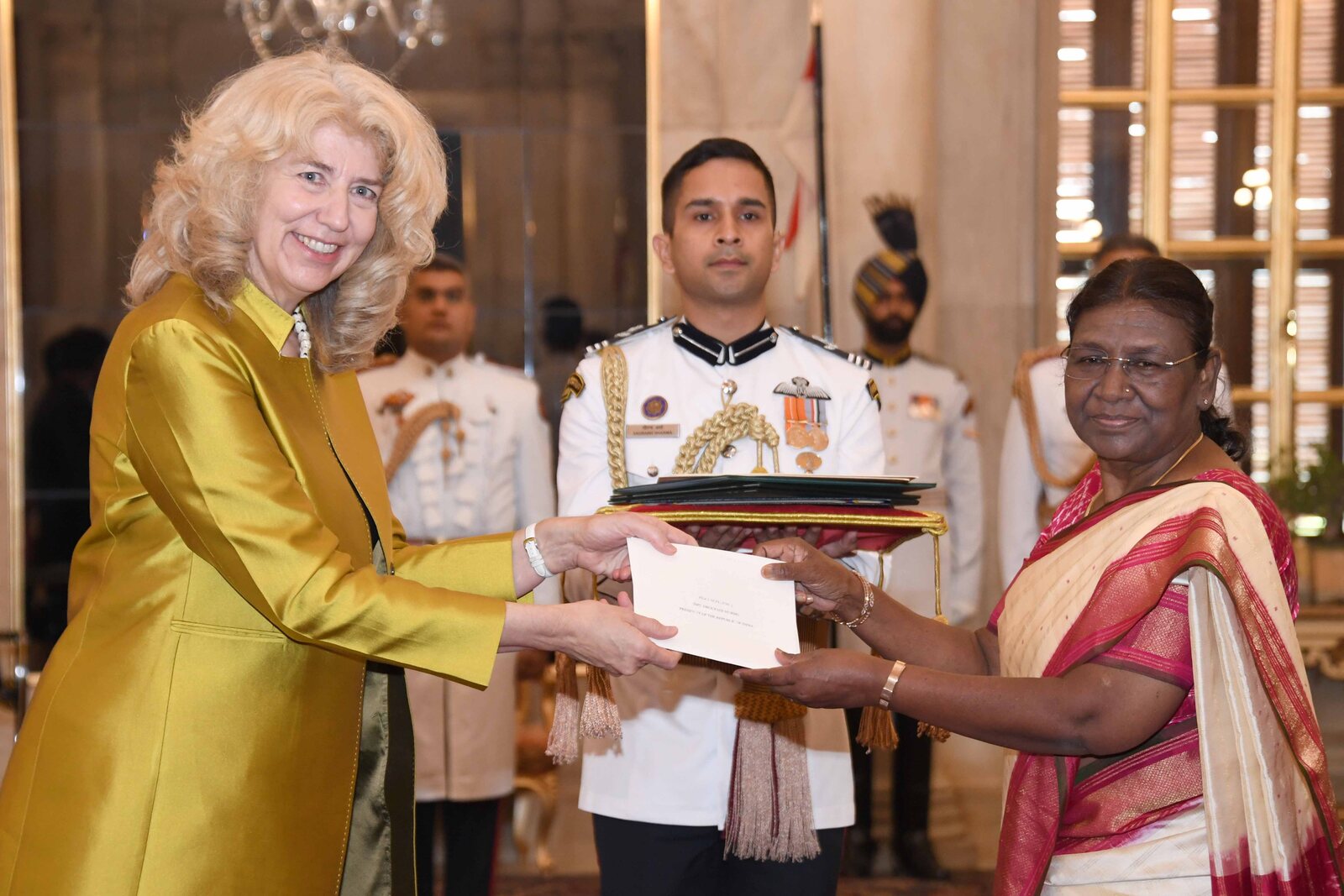
India’s treaties are negotiated and concluded in the name of the President. Ambassadors and High Commissioners of India are appointed by the President, and the envoys of other states accredited to India present their letters of credence to the President in person at Rashtrapati Bhavan.
The ceremony is short and entirely formal, and it is the moment at which a foreign mission acquires standing in India. It is one of the clearest illustrations of what the office is for: a Head of State exists so that a Republic has a single, continuous person in whom its international personality is expressed.
State visits abroad are made in the same capacity. President Murmu has undertaken State visits to more than a dozen countries, in several of which no Indian Head of State had previously set foot.
VIII — The states
The President and the federal structure
The President appoints the Governor of every state under Article 155, and a Governor holds office during the President’s pleasure under Article 156. Under Article 201, a Bill reserved by a Governor for the President’s consideration comes to the President, who may assent, withhold assent, or direct the Governor to return it to the state legislature.
Under Article 3, no Bill to form a new state or alter the area, boundaries or name of an existing one may be introduced in Parliament except on the recommendation of the President, and only after the views of the affected state legislature have been sought.
Under Article 263 the President may establish an Inter‑State Council; under Article 280 the President constitutes a Finance Commission every five years to recommend the distribution of tax revenue between the Union and the states. The office sits, structurally, at the hinge of Indian federalism.
Part XVIII
Emergency provisions
Three articles allow the constitutional order to be altered in an emergency. Each was drafted with the memory of partition and with an acute awareness of how such powers can be misused; each has been narrowed considerably since 1975, most importantly by the Forty‑Fourth Amendment of 1978 and by the Supreme Court’s judgment in S. R. Bommai in 1994.
- Art. 352Proclamation of Emergency on grounds of war, external aggression or armed rebellion — only on the written advice of the Cabinet, and subject to parliamentary approval
- Art. 356Proclamation where the government of a state cannot be carried on in accordance with the Constitution — subject to parliamentary approval and to judicial review
- Art. 360Financial emergency, where the financial stability or credit of India is threatened — never yet invoked
IX — Convention
Where the text stops and practice begins
A great deal of what the President does is governed by convention rather than by express text. The Constitution does not say whom the President must invite to form a government when no party has a majority; practice, and the reports of successive commissions on Centre–State relations, supply the answer. The Constitution does not fix a timetable for assent to a Bill; the Supreme Court and the Governors’ practice have addressed it.
Three conventions are worth naming, because they define the office as it is actually held:
- The President does not speak politically. Public statements are made in the capacity of Head of State, on themes of national rather than partisan significance.
- The President is informed. Article 78 is used continuously rather than exceptionally; the flow of information from government to Rashtrapati Bhavan is routine.
- Discretion is reserved, not spent. The powers to return advice, to return a Bill, and to seek information are used sparingly, which is what makes them meaningful when used.
Under Article 143 the President may also refer a question of law or fact of public importance to the Supreme Court for its opinion — a channel used rarely, and in each instance on a question of genuine constitutional difficulty.
Continue