Fifteenth President of the Republic of India
Droupadi Murmu
President of India
From a village in the Mayurbhanj hills to the highest constitutional office of the Republic — a life of public service, constitutional responsibility and national leadership.

01 — The Journey
A life that begins in a village of the Mayurbhanj hills
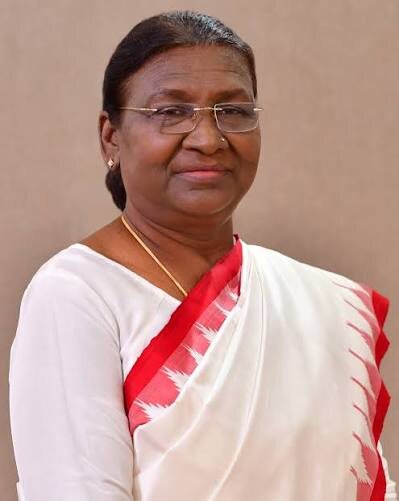
Droupadi Murmu was born on 20 June 1958 in Uparbeda, a village in the Rairangpur region of Mayurbhanj district, in the northern uplands of Odisha. Her family belonged to the Santal community, one of the largest Adivasi peoples of eastern India.
Her father, Biranchi Narayan Tudu, farmed. Both he and her grandfather served as village headmen under the traditional and panchayat systems of local self-government — so the idea that authority is something entrusted by a community, and answerable to it, was present in the household long before it became a matter of constitutional office.
She travelled to Bhubaneswar for her secondary schooling and then to Rama Devi Women’s College, where she took a Bachelor of Arts degree. She was the first girl from her village to attend college. The distance between Uparbeda and the state capital was not merely geographic; in the Odisha of the early nineteen‑seventies it was a distance measured in expectations.
02 — A Life of Public Service
Work first, then the classroom, then the ward
Public service began, as it often does, without ceremony. Between 1979 and 1983 she worked as a junior assistant in the Irrigation and Power Department of the Government of Odisha. Later, from 1994 to 1997, she taught at the Sri Aurobindo Integral Education and Research Centre at Rairangpur — as an honorary assistant teacher, without drawing a salary.
In 1997 she was elected a councillor of the Rairangpur Nagar Panchayat and went on to serve as its vice‑chairperson. It is among the smallest units of elected government in the country, and it is where her public career started: drains, roads, schools, water, and the daily arithmetic of a small town’s budget.
Nothing about that beginning was symbolic. It was the ordinary apprenticeship of democratic office, served in full.
03 — Leadership
Through Institutions
Each office held in full, and in sequence
The progression is unusually complete. Ward councillor. Member of a state legislative assembly, twice. Minister of State with independent charge, twice. Governor of a state for more than six years. Then Head of State.
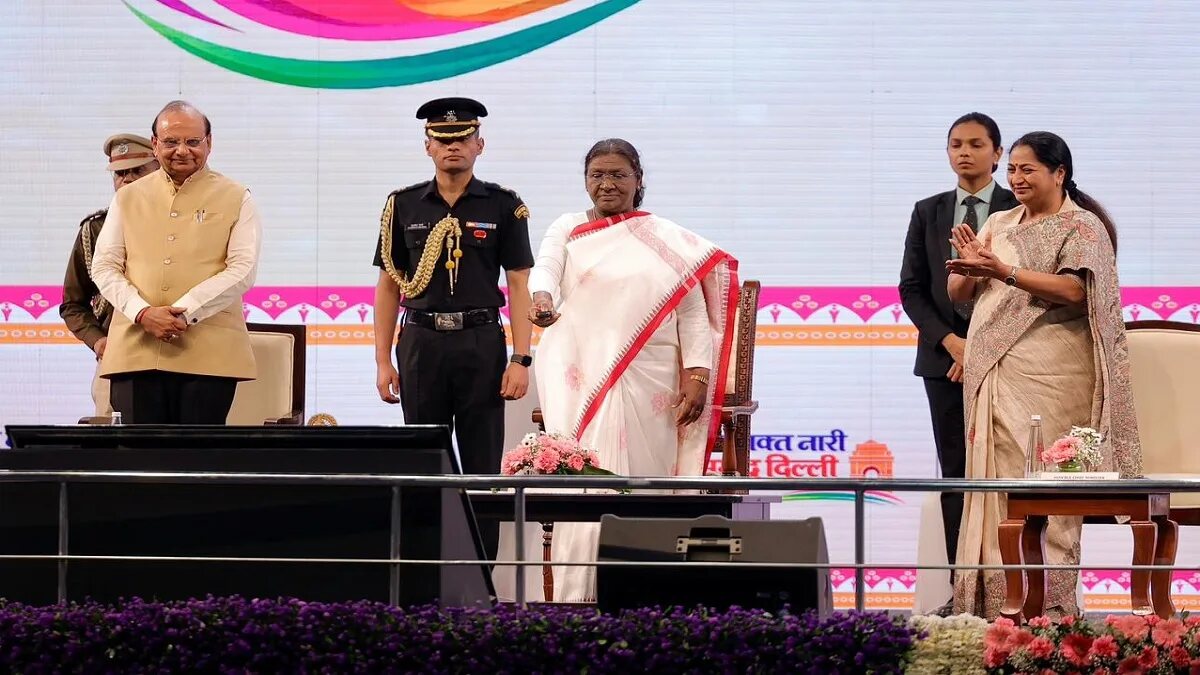
She was elected to the Odisha Legislative Assembly from Rairangpur in 2000 and again in 2004. In the state government she held independent charge of Commerce and Transport from 6 March 2000 to 6 August 2002, and of Fisheries and Animal Resources Development from 6 August 2002 to 16 May 2004. In 2007 the Odisha Legislative Assembly named her Best MLA of the year, conferring the Nilkantha Award.
What that record describes is a public life built inside institutions rather than around them — local government, legislature, executive, and finally the two constitutional offices of Governor and President.
04 — Raj Bhavan
Governor of Jharkhand, 2015–2021
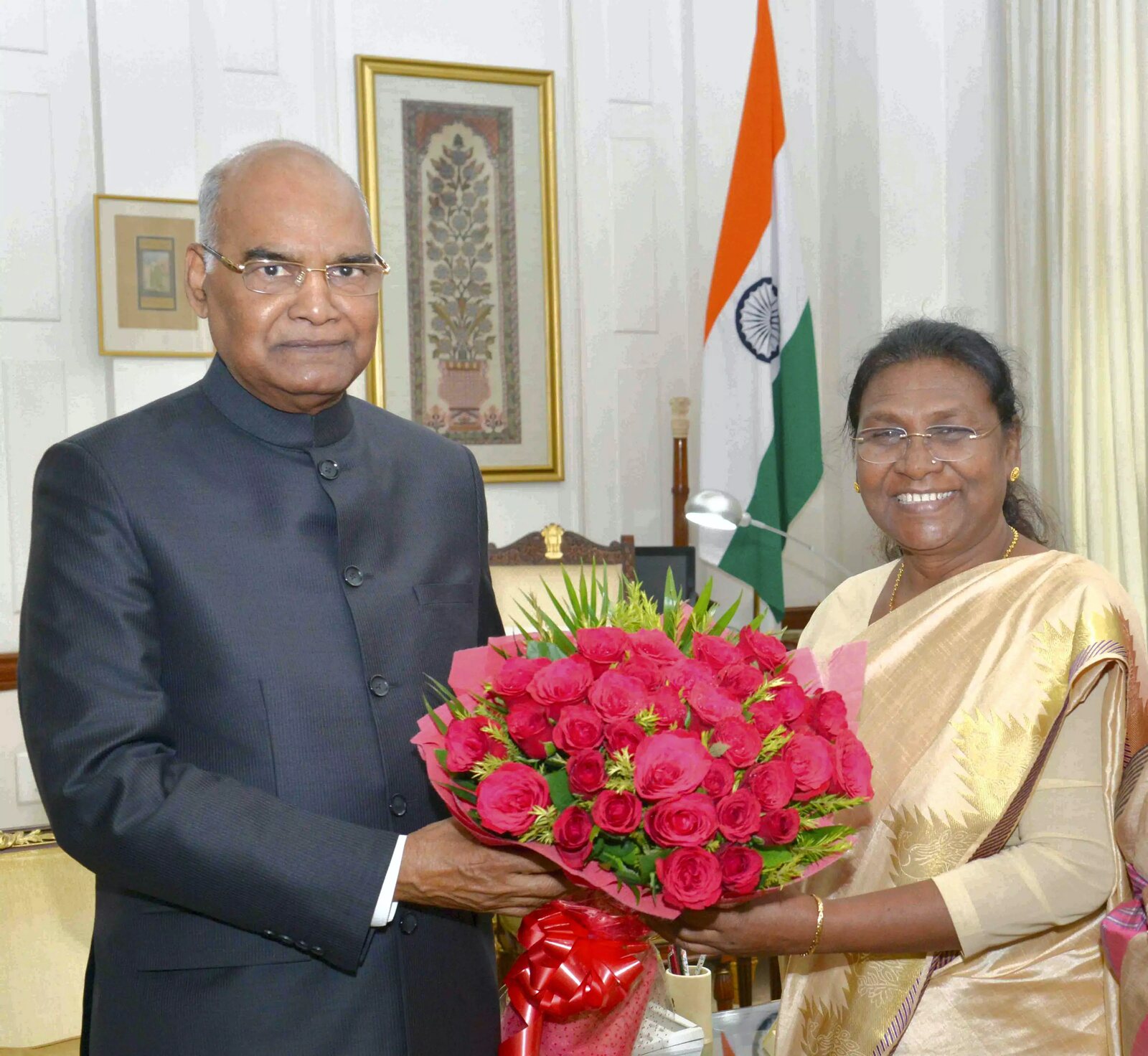
On 18 May 2015 Droupadi Murmu was sworn in as Governor of Jharkhand. She was the first woman to hold the office, and by the end of her tenure in July 2021 she had become the longest‑serving Governor in the state’s history — and the first to complete a full five‑year term.
A Governor of an Indian state is the constitutional head of its executive and, in practice, the guardian of process: administering oaths of office, summoning and proroguing the legislature, and deciding what to do with the Bills that legislature sends up. Article 200 of the Constitution allows a Governor to assent to a Bill, to withhold assent, or to return a Bill that is not a Money Bill for the reconsideration of the House.
In May 2017 she used that power. Amendments to the Chhotanagpur Tenancy Act, 1908 and the Santhal Pargana Tenancy Act, 1949 — the two statutes that restrict the transfer of tribal land in the state — were returned to the Jharkhand government for reconsideration, after her office received a very large volume of representations from tribal communities and organisations across the state.
The Office of Governor
What a Governor does
- AppointmentBy the President, under Article 155
- ExecutiveHead of the state executive; appoints the Chief Minister
- LegislatureSummons, prorogues and may dissolve the Assembly
- BillsMay assent, withhold assent, return, or reserve a Bill for the President
- UniversitiesChancellor of the state universities
05 — The Presidency
Elected by the Republic, July 2022
The President of India is not elected by the people directly. Under Article 54, the electoral college consists of the elected members of both Houses of Parliament and the elected members of the legislative assemblies of the states, of the National Capital Territory of Delhi and of Puducherry — voting by proportional representation and single transferable vote.
Polling took place on 18 July 2022. When the votes were counted on 21 July, Droupadi Murmu had secured 676,803 of the 1,086,431 votes in the electoral college — 64.03 per cent — against 380,177 for Shri Yashwant Sinha. She took the oath of office on 25 July 2022 in the Central Hall of Parliament, administered by the Chief Justice of India, Shri N. V. Ramana.
She became the fifteenth President of India, the second woman to hold the office, the first person from a Scheduled Tribe to do so, and the first President born after independence.
06 — The Office of the President
What the office constitutionally represents
Article 52 of the Constitution of India is a single sentence: There shall be a President of India. Everything that follows — the executive power of the Union, the summoning of Parliament, assent to legislation, the appointment of judges and Governors, the power of clemency, the supreme command of the armed forces — proceeds from that sentence.
The President is the Head of State. The executive power of the Union is vested in the President under Article 53, and is exercised either directly or through officers subordinate to the office. Under Article 74, the President acts on the aid and advice of the Council of Ministers headed by the Prime Minister, and may require that advice to be reconsidered once — after which the reconsidered advice is binding.
It is a common error to describe this office as merely ceremonial. It is more accurate to say that it is the office in which the continuity and the formal legality of the Indian state are held. Every Act of Parliament requires the President’s assent. Every Prime Minister is appointed by the President. Every Governor, every Chief Justice, every Chief Election Commissioner takes office by presidential warrant.
07 — National and International Engagements
The Republic, represented
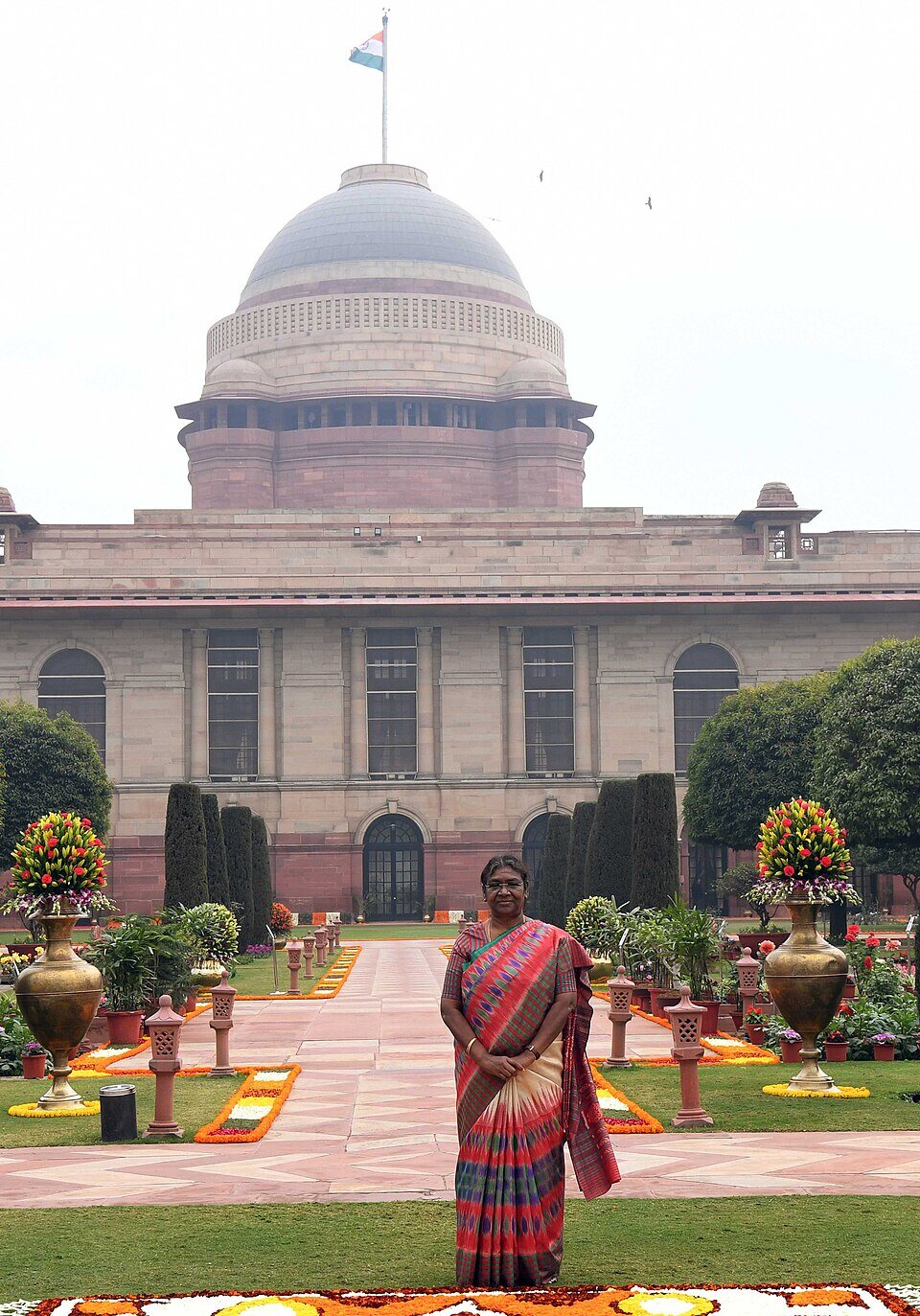
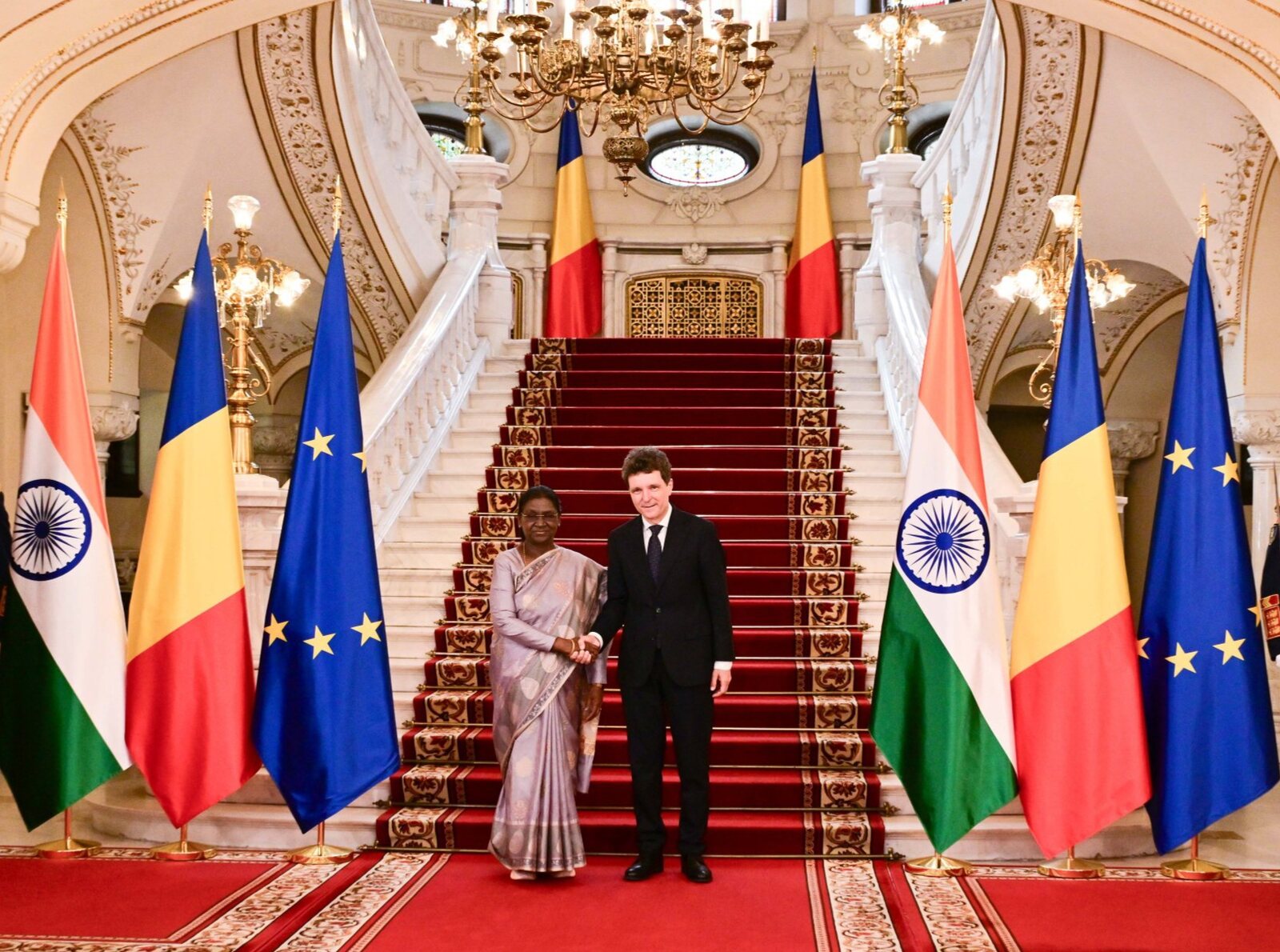
Under Article 53 and by long constitutional convention, the President represents India in its dealings with other states. Ambassadors and High Commissioners present their credentials to the President; treaties are concluded in the President’s name; and State visits abroad are made as Head of State.
2022 – 2023
First journeys
London for the State Funeral of Queen Elizabeth II in September 2022; then State visits to Suriname and Serbia in June 2023, the first by an Indian President to either country.
2024
The Pacific and Africa
Mauritius in March; Fiji, New Zealand and Timor‑Leste in August; Algeria, Mauritania and Malawi in October — several of them the first visits by an Indian President.
2025 – 2026
Europe and southern Africa
Portugal and Slovakia in April 2025; Angola and Botswana in November 2025; Moldova, North Macedonia and Romania in July 2026.
08 — Speeches and Addresses
The presidential address as a constitutional instrument
The President addresses the country twice each year by convention — on the eve of Republic Day and on the eve of Independence Day. Article 87 requires the President to address both Houses of Parliament assembled together at the commencement of the first session after each general election, and at the commencement of the first session of each year. That address sets out the policies of the Union Government, and is the only speech in the Indian system that Parliament formally debates and votes upon by way of a Motion of Thanks.
President Murmu delivered her first address to the nation on 14 August 2022, on the eve of the seventy‑sixth Independence Day. She has since addressed joint sittings of Parliament — including the first session of the eighteenth Lok Sabha on 27 June 2024 — and has addressed the legislatures of Fiji, Angola, Botswana and North Macedonia as a guest of those states.
09 — Milestones
Sixty-eight years, in sequence
A public life is best read in order. Below, the turning points; the full chronology, with context for each, is set out on the milestones page.
Born at Uparbeda
Born on 20 June in Uparbeda village, Mayurbhanj district, Odisha, into a Santal family.
Government service
Junior assistant, Irrigation and Power Department, Government of Odisha, until 1983.
The classroom
Honorary assistant teacher at the Sri Aurobindo Integral Education and Research Centre, Rairangpur, until 1997.
First elected office
Elected councillor of the Rairangpur Nagar Panchayat; later its vice-chairperson.
Legislature and ministry
Elected MLA from Rairangpur; Minister of State with independent charge for Commerce and Transport.
Raj Bhavan, Ranchi
Sworn in on 18 May as Governor of Jharkhand — the first woman to hold the office.
President of India
Elected on 21 July with 64.03 per cent of the electoral college; sworn in on 25 July.
Scroll for more
10 — Legacy
A record still being written
The significance of this presidency will be assessed, in the end, by historians rather than by contemporaries. What can be stated now is factual and narrow: that the first person from a Scheduled Tribe to hold the office of Head of State reached it through the ordinary institutions of Indian democracy — a municipal ward, a state legislature, a ministry, a Raj Bhavan — and that this route was available and was taken.
For a Republic that wrote representation into its founding document and then spent seventy‑five years testing whether the promise could be kept, that is a matter of constitutional record, not of commentary.

Explore