The Journey · Early Life
Uparbeda, Mayurbhanj, 1958
Where the life began: a village in the northern uplands of Odisha, a Santal household in which the office of village headman had passed from one generation to the next, and a childhood lived at the far edge of what the young Republic could yet deliver.
The Place
A district of forest, iron and the Santal
Mayurbhanj is the largest district of Odisha by area and one of the most heavily Adivasi districts in India. Its northern uplands run into the Similipal massif; its eastern boundary meets West Bengal, its northern one Jharkhand. Uparbeda, where Droupadi Murmu was born, is one of a group of revenue villages in the Rairangpur area of the district.
Mayurbhanj was a princely state until 1949, when it acceded to the Indian Union and was merged into Odisha. That is a recent date: the administrative machinery of an Indian state — revenue offices, block development structures, public schooling, primary health — reached the district only in the decades after independence, and reached its remoter villages later still.
The Santal are the dominant community of the region. They are among the largest Adivasi peoples of the subcontinent, spread across Jharkhand, West Bengal, Odisha, Bihar and Assam, with a substantial population in Bangladesh and Nepal. Their language, Santali, was included in the Eighth Schedule of the Constitution by the Ninety‑Second Amendment in 2003 — giving formal recognition, forty‑five years after Droupadi Murmu’s birth, to the language she was born speaking.
The Record
Birth and origin
The Household
Authority as custody
Her father, Biranchi Narayan Tudu, farmed and served as the headman of Uparbeda. So had her grandfather. In Santal practice the headman — the manjhi — is not a landlord and not an appointee. He convenes, arbitrates, represents the village to outside authority, and holds a position the village confers and can withdraw.
After independence the Panchayati Raj system laid a statutory framework over that older arrangement, so that by the time of Droupadi Murmu’s childhood the village headman was simultaneously a customary figure and a unit of the Indian state. Her family occupied both roles at once.
This matters for reading the rest of the life. The distinctive quality of her public career is not ambition for high office but a very literal understanding of office as something held in trust and accounted for. The first place she would have seen that practised was her own house.
Childhood
What a village school could offer in 1965
She began her schooling in Uparbeda itself. The conditions are a matter of public record rather than of anecdote: in the Odisha of the mid‑nineteen‑sixties, rural schooling was thinly resourced, female literacy in tribal districts was among the lowest in the country, and the expectation for most girls was a few years of primary education followed by work in the household and the fields.
Very little of her childhood has been placed on the public record in detail, and this page does not invent it. What is documented is the outcome: she completed her primary schooling in the village, was sent away for secondary education, and finished a degree. Each of those steps was, statistically, unusual for a girl of her background and generation.
The name she carries is itself part of the story. Her parents gave her a Santal name; the name Droupadi was given to her at school by a teacher. She has said so herself in public. It is the kind of small translation that thousands of Adivasi children of that generation underwent on entering the formal education system, and it is recorded here because she has chosen to speak about it rather than leave it out.
Historical Context
The India she was born into
A life is easier to read against the calendar of the state it belongs to. These are the dates that frame her first decades.
-
1949
Mayurbhanj accedes to the Indian Union
The princely state of Mayurbhanj is merged into Odisha, becoming a district of the state. The apparatus of modern administration begins to extend into its interior.
-
1950
The Constitution comes into force
On 26 January the Constitution of India takes effect. Articles 15 and 16 prohibit discrimination; Articles 330, 332 and 335 provide for the representation of the Scheduled Castes and Scheduled Tribes; the Fifth Schedule provides a distinct administrative regime for Scheduled Areas, of which large parts of Mayurbhanj are one.
-
20 June 1958
Born at Uparbeda
Born into a Santal family in Uparbeda village, Mayurbhanj district, Odisha. Her father and grandfather both served as village headmen.
-
1959 – 1960s
Panchayati Raj takes shape
India begins building an elected three‑tier system of rural local government. It is not yet constitutionally entrenched — that would come in 1992 — but it establishes the ladder that her own public career would later begin on.
-
1970s
Secondary school and college
She leaves the district for secondary schooling in Bhubaneswar, and then reads for a Bachelor of Arts at Rama Devi Women’s College — the first girl from her village to attend college.
-
2003
Santali enters the Eighth Schedule
The Ninety‑Second Constitutional Amendment adds Santali, Bodo, Dogri and Maithili to the Eighth Schedule — formal constitutional recognition of the language of her community.
Faith and Community
What she carried forward
The Santal world she came from has its own religious tradition, centred on Sarna — the sacred grove — and on a body of practice tied closely to land, forest and season. Adivasi communities across eastern India have argued for decades for the distinct recognition of that tradition in the census.
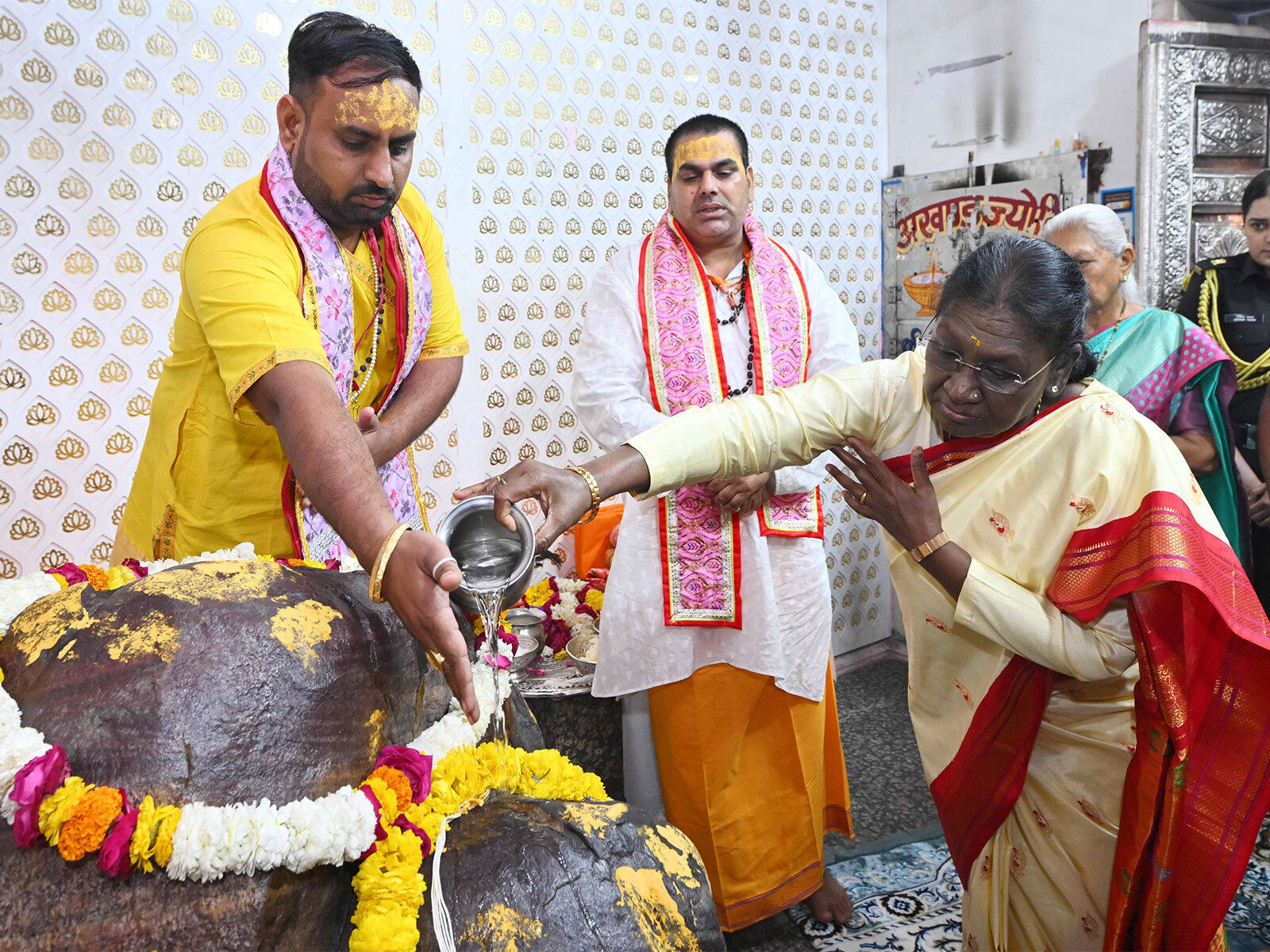
Alongside it, and characteristic of the region, is a long history of participation in the wider devotional life of Odisha. As President she has visited temples and shrines across the country in the ordinary course of her public engagements, and made her first return to Odisha as Head of State in November 2022, when she went to the Jagannath Temple at Puri.
She has also been associated for many years with the Brahma Kumaris, and has spoken of meditation as part of how she absorbed a series of severe personal losses between 2009 and 2015.
Continue