3 August 2022
Shri Suresh N. Patel
Central Vigilance Commissioner.
The Presidency · since 25 July 2022
Elected on 21 July 2022 with 64.03 per cent of the electoral college and sworn in four days later, Droupadi Murmu holds the office in which the continuity and the formal legality of the Indian state are vested.
The Election
The President of India is not elected by direct popular vote. Article 54 provides that the President is elected by an electoral college consisting of the elected members of both Houses of Parliament and the elected members of the legislative assemblies of the states, together with those of the National Capital Territory of Delhi and of Puducherry.
Article 55 requires that, so far as practicable, there be uniformity in the scale of representation of the different states, and parity between the states as a whole and the Union. Each MLA’s vote is therefore weighted by the population of the state — still calculated on the 1971 Census — divided by the number of elected members; each MP’s vote is weighted so that the total value of parliamentary votes equals the total value of assembly votes. Voting is by secret ballot, using the system of proportional representation by means of the single transferable vote.
A candidate must therefore secure more than half the total value of votes cast — not merely a plurality.
Counting took place on 21 July 2022. Droupadi Murmu received 676,803 votes by value against 380,177 for Shri Yashwant Sinha, the joint candidate of seventeen opposition parties — a margin of 296,626. She was declared elected the same day.
25 July 2022
Article 60 of the Constitution prescribes the form of words. The President swears or affirms to faithfully execute the office, and to preserve, protect and defend the Constitution and the law, and to devote himself or herself to the service and well‑being of the people of India. The oath is administered by the Chief Justice of India, or in the Chief Justice’s absence by the senior‑most judge of the Supreme Court.
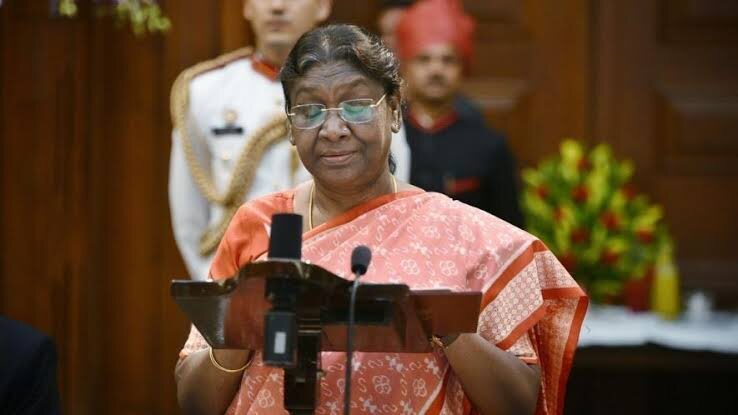
On 25 July 2022, in the Central Hall of Parliament, the oath was administered to Droupadi Murmu by the Chief Justice of India, Shri N. V. Ramana. She succeeded Shri Ram Nath Kovind as Head of State.
Reaching this office is not my personal achievement but that of all the poor people in the country. Address in the Central Hall of Parliament, 25 July 2022, as reported
Matters of record
Constitutional functions
The presidency is often described as ceremonial. It is more accurate to say that its powers are exercised on ministerial advice, and that the office nonetheless remains the point through which the constitutional acts of the Union must pass.
Executive
Under Article 75 the President appoints the Prime Minister, and the other ministers on the Prime Minister’s advice. After the 2024 general election, President Murmu appointed Shri Narendra Modi Prime Minister and administered the oath of office to him and to the Union Council of Ministers on 9 June 2024.
Legislative
No Bill passed by Parliament becomes law without the President’s assent under Article 111. Under Article 87 the President addresses both Houses assembled together at the start of the first session after each general election and of the first session of each year — as she did for the eighteenth Lok Sabha on 27 June 2024.
Judicial
Judges of the Supreme Court and the High Courts are appointed by warrant under the President’s hand and seal. President Murmu has administered the oath of office to successive Chief Justices of India, and holds the power of clemency under Article 72.
Diplomatic
Ambassadors and High Commissioners accredited to India present their letters of credence to the President at Rashtrapati Bhavan. Treaties are concluded in the President’s name, and State visits abroad are made as Head of State.
A record of the office
Among the most visible constitutional acts of a President is the administration of the oath of office to the highest officers of the Republic. The following are on the public record for the current presidency.
Central Vigilance Commissioner.
Fourteenth Vice-President of India.
Forty-ninth Chief Justice of India.
Fiftieth Chief Justice of India.
Central Vigilance Commissioner.
Prime Minister of India, on the formation of the government following the 2024 general election, together with the Council of Ministers.
Fifty-first Chief Justice of India.
Comptroller and Auditor General of India.
Fifty-second Chief Justice of India.
Fifteenth Vice-President of India.
Fifty-third Chief Justice of India.
Article 53(2)
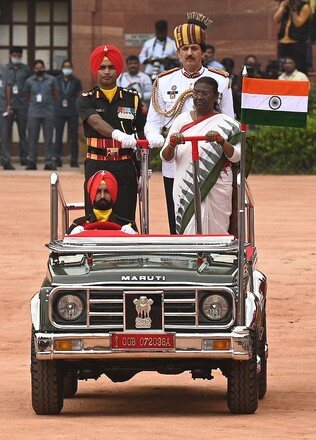
Article 53(2) vests the supreme command of the Defence Forces of the Union in the President. The clause is precise about what that means: the exercise of that command is to be regulated by law. Operational command rests with the Chiefs of Staff and, through the Union Government, with the Cabinet. What the President holds is the constitutional headship of the armed forces — commissions are granted in the President’s name, gallantry awards are conferred by the President, and the President receives the salute at the Republic Day parade.
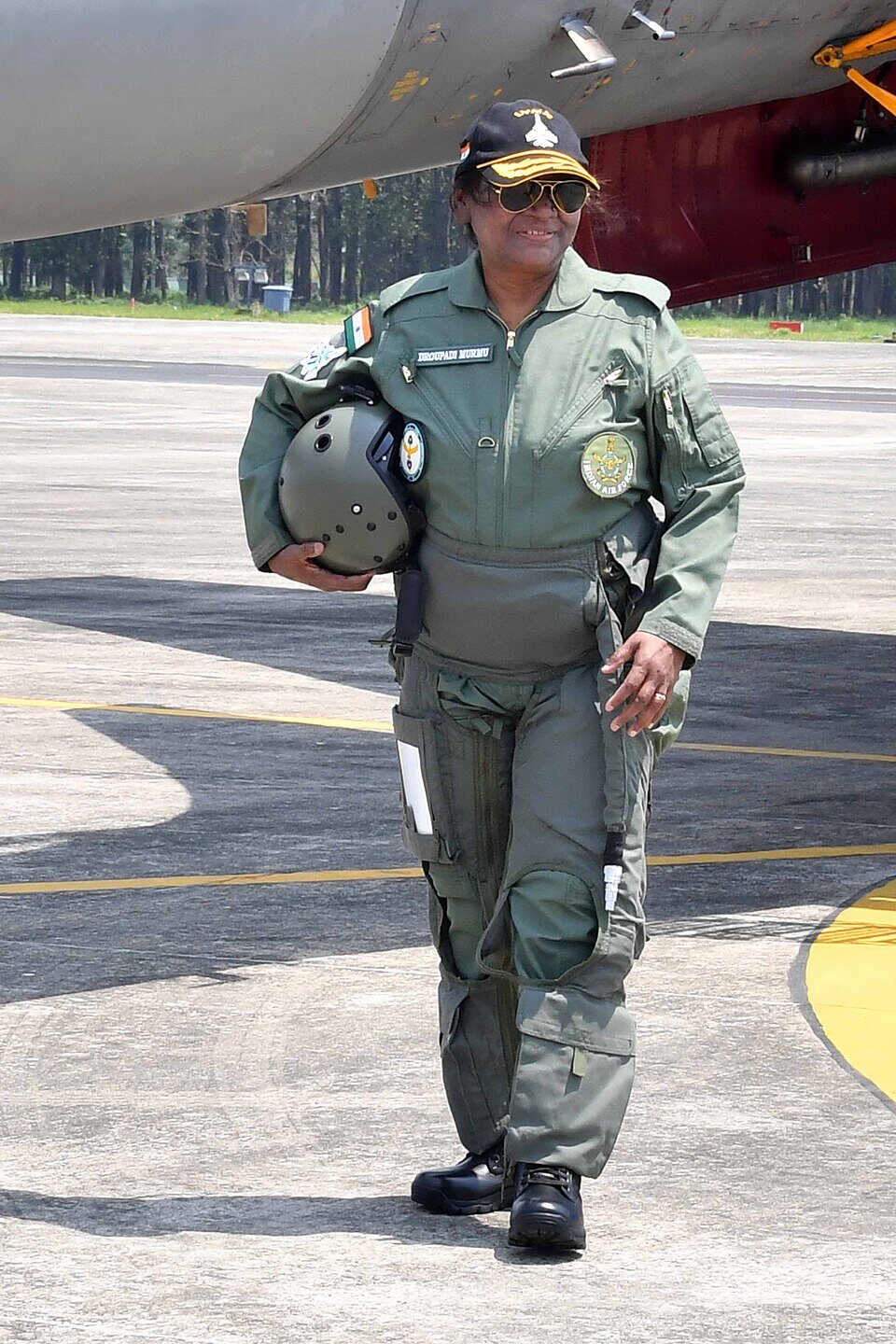
On 8 April 2023 President Murmu flew a sortie in a Sukhoi‑30 MKI from Tezpur Air Force Station in Assam, becoming the third President of India to fly in a fighter aircraft.
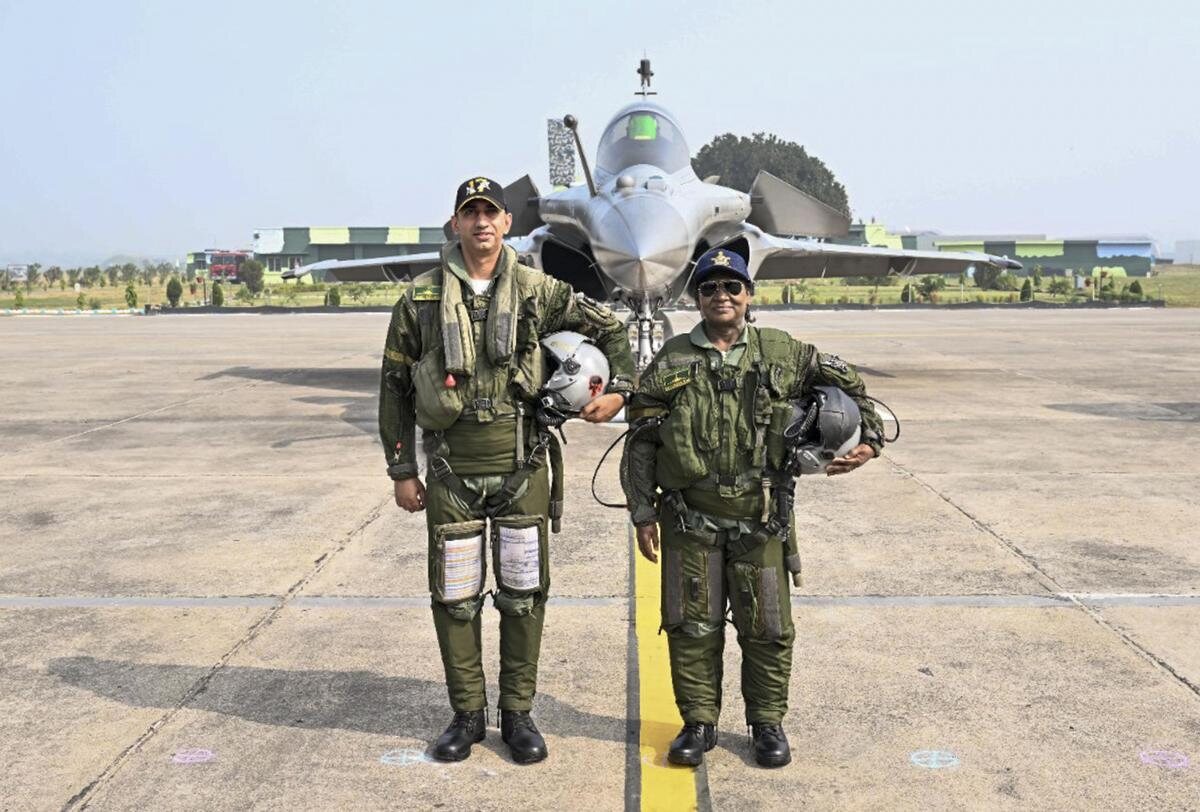
On 29 October 2025 she flew again, this time in a Rafale from Air Force Station Ambala in Haryana — the base at which the first Rafale aircraft were inducted into the Indian Air Force. The flight lasted approximately thirty minutes and covered about two hundred kilometres. She is the first President of India to have flown in two different fighter types.
These are not symbolic gestures in the ordinary sense. The Supreme Commander of the Defence Forces flying in the front‑line aircraft of the air force she constitutionally heads is a deliberate statement about the relationship between the civil head of state and the armed forces of a republic.
Rashtrapati Bhavan
Rashtrapati Bhavan was completed in 1929 as the Viceroy’s House and became the residence of the President of India in 1950. Two changes made during President Murmu’s tenure have altered how the building presents itself.
In January 2023 the gardens, until then called the Mughal Gardens, were given the common name Amrit Udyan, announced in the context of the seventy‑fifth anniversary of independence. Their annual opening to the public has since become a fixture of the Delhi calendar.
In July 2024 the two principal ceremonial halls were renamed: the Durbar Hall, where national awards are conferred, became Ganatantra Mandap, and the Ashok Hall became Ashok Mandap. The President’s Secretariat explained that the word durbar referred to the courts and assemblies of rulers and had lost its relevance once India became a republic — a ganatantra.
It is in the Ganatantra Mandap that the Padma awards and the Bharat Ratna are conferred. In March 2024 President Murmu presented the Bharat Ratna to Shri L. K. Advani at his residence, in the presence of the Vice‑President, the Prime Minister and senior ministers.
Continue